
Media Trends
In a previous issue of Eagle’s Perspective , we shared that podcasts recently surpassed AM/FM radio as the preferred delivery method for spoken-word audio listening in the United States.
And while the conversation around radio versus podcasts isn’t going away, new data suggests it might not be as simple as all that.
According to Edison Research’s latest Share of Ear data, spoken-word audio listening among people 13+ is nearly evenly split between AM/FM radio (39%) and podcasts (40%).
At a surface level, it looks like a tie. But age tells a different story.
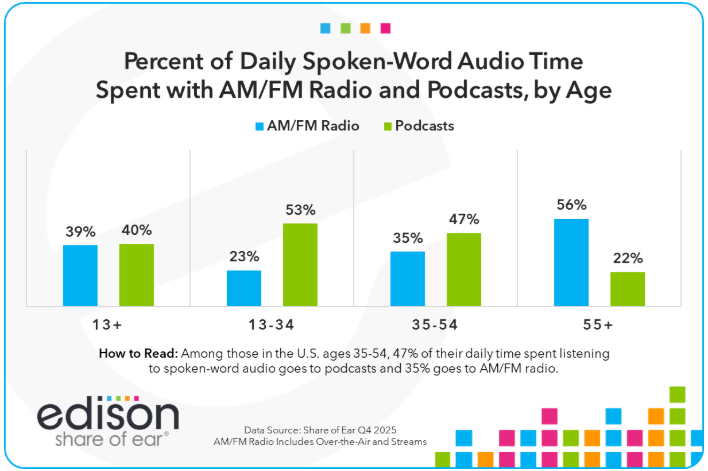
Among listeners aged 13–34, podcasts dominate—accounting for 53% of spoken-word listening compared to just 23% for radio. This preference continues with ages 35–54, where podcasts still lead at 47% versus 35% for radio.
The pattern flips with audiences 55+, where AM/FM radio remains dominant at 56%, while podcasts account for just 22%.
What looks like a balanced channel landscape is actually a generational divide in how people choose to listen.
Why It Matters
If your audio strategy leans too heavily in one direction, you’re likely missing a portion of your audience.
Younger listeners have formed habits around on-demand, personalized audio. Older audiences remain deeply connected to broadcast radio. Both are highly engaged, but in very different places.
Reaching today’s listening audience requires more than choosing the “winning” channel. It means understanding how listening behaviours shift across life stages, and building a presence that reflects this.
Because the question isn’t about radio or podcasts, it’s about whether your message is showing up where your audience is already listening.
Next Steps
Take a fresh look at your audience mix. If you’re trying to reach multiple generations, consider how your strategy shows up across both broadcast and on-demand audio, and where you may be underrepresented.
Where is your audience actually listening today? Are you meeting them there?
 Shauna Goodison
Director of Communications | shauna@eaglecom.ca